
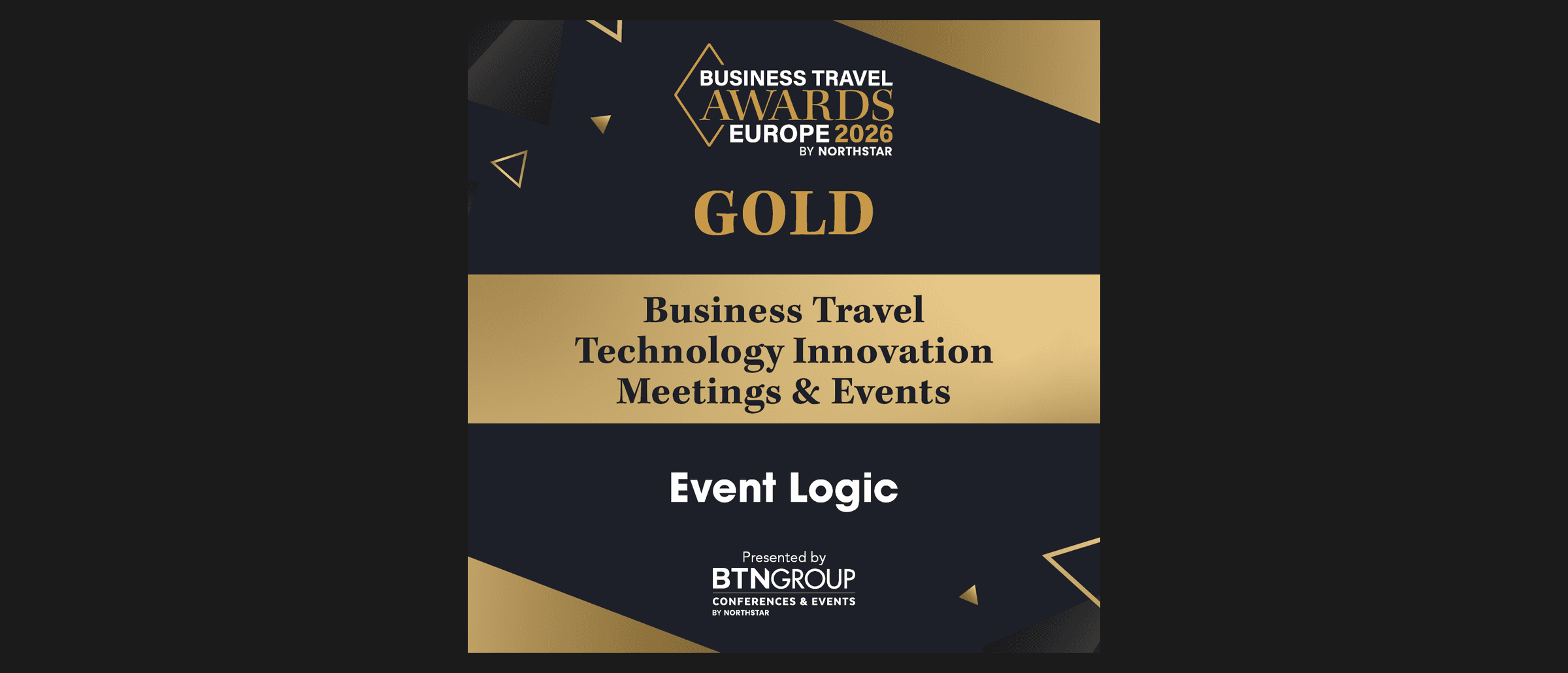
Event Logic wins Business Travel Awards Europe 2026
Event Logic
Event Logic won the Business Travel Technology Innovation – Meetings & Events category at Business Travel Awards Europe 2026. We are enormously proud to say it out loud.
The competition was fierce, with far larger players from across Europe and the rest of the world on the shortlist, and we are honoured to have come out on top. The category goes to the technology the judges rate as the strongest innovation in business travel for meetings and events, and it is decided on evidence: a real problem solved, and measurable results that last for the customers using it.
The platform behind the entry is not new. It has been built, rebuilt and extended for more than ten years, with the booking flow, the supplier integrations and the data model reworked as the market and the requirements changed.
What does the category actually reward?
Not a concept, and not a roadmap. The judges ask what problem the technology set out to solve in the meetings and events market, and then ask for proof that it got solved. Adoption, cost, time, conversion, user satisfaction. Documented, over time, with customers who kept using it.
That is a harder bar than it sounds. Plenty of meetings tooling demonstrates well and then sits unused because the agreed route still takes longer than the quickest one. Closing that gap is mostly engineering work: instant booking against live supplier data, CO₂ calculated at the point of booking, and policy logic that runs in the background instead of as extra steps in the interface.
What did the judges say?
The judges noted Event Logic's ability to make meetings procurement simpler for users while improving control, compliance and visibility for organisations. They highlighted its user-friendly approach, instant booking and CO₂ tracking capabilities, backed by strong evidence of adoption, cost and time savings, increased conversion and high user satisfaction.
Why does that wording matter if you own the meetings programme?
The first sentence contains the whole tension in meetings procurement. Simpler for the person booking, stronger control for the organisation. Those two usually pull against each other, because control is normally added as steps, and steps are the first thing to go when the meeting planner has a date, a budget and a deadline that was set before the policy existed. Resolving that in software, rather than in policy documents, has been the main development problem for most of the past decade.
Adoption is the number that decides whether the rest is worth anything. A system reports what goes through it and nothing else, so low adoption does not just mean low usage. It means your spend data is a sample, and you do not know how big a sample.
CO₂ per booking belongs in the same argument. Emissions from meetings and events sit in Scope 3, and that is the part of the reporting that is close to impossible to reconstruct once the invoices have landed. Captured at booking, it is a field. Captured afterwards, it is a project.
What an award changes
Nothing, on the Monday after. What the criteria are useful for is as a checklist when you evaluate any meetings technology: can it show adoption, savings and satisfaction with evidence from named customers, over more than one year?
Thanks to the judges, and to the customers whose numbers and feedback were the actual submission.
If you want to look at it closer
If control, compliance and visibility are on your list this year, the useful starting point is usually what your own numbers already show about where meetings spend ends up. We can go through that with you and walk through how the product handles it.
Seeing where your meetings spend actually lands is easier than most people expect, and it is a good place to start.